

I’m not a bible thumper, by any means at all, but, I do regard both the Abrahamic doctrines and the Gnostic traditions as steeping full of old world wisdom that a great much of is lost to current generations. I often find tropes and themes in them that ring universally true even in modern times. Situations that arise from the natures of men and their characters, and are not merely situational responses to the times and cultures they live in (which much of human behaviour and belief is).
Like I said — I don’t subscribe to dogma. I don’t subscribe to the Christian religion or even really to an Abrahamic faith. I’m sure the Pope would not like my spiritual views. Hell, I don’t either. But, there is the occasional moment in those old stories that serve like pieces of a shattered chalice of wisdom.
One of those shattered pieces, for me, is the figure of Judas Iscariot — and the patch of ground that took his name when he was done with it. He was an actual person.
Judas Iscariot was one of the twelve men who ran with Jesus of Nazareth in first-century Judea. The twelve, called the apostles, were his inner circle. Within that circle Judas had a specific job: he carried the money. He was the treasurer, the one the others trusted with the purse. The Gospel of John — one of the four short biographies of Jesus that open the Christian New Testament — mentions in passing that he used to dip into it. So the rot was already there before the famous moment ever arrived.
The famous moment is straightforward. The Temple priests in Jerusalem wanted Jesus arrested without drawing a crowd, and Judas sold them what they needed for thirty pieces of silver. A few nights later, after a last shared meal, he walked an armed party out to the garden where Jesus was praying and pointed him out with a kiss so the soldiers would know who to grab. That was it. The man whose job was to hold the money handed over the teacher for more of it.
What I find worth sitting with is what the texts say happened next, because they can’t agree, and the disagreement is the interesting part. The Gospel of Matthew says Judas was hit by remorse, threw the silver back at the priests, and hanged himself; the priests, unwilling to put blood money in the Temple treasury, used it to buy a potter’s field as a burial ground for foreigners, and the place came to be called the Field of Blood. The Acts of the Apostles — a fifth book in the New Testament that picks up after Jesus is killed — tells it differently: Judas himself bought the field with the money, and there fell headlong and burst open in the middle, his insides spilling out on the ground. Same field, same name, different death. And an early second-century writer named Papias, who collected stories from people who had actually known the apostles, preserved a third version: Judas didn’t die quickly. He swelled. His body bloated and distended until he ruptured from it. A man so engorged by what he had taken on that he couldn’t hold himself together.
You don’t have to believe any of it literally to feel the pattern underneath. Three different ancient sources reaching for three different images of the same man, and all three of them are images of a body that cannot contain what has been put inside it. The rope, the burst gut, the swelling — they’re all the same idea told three ways. And all of them, one way or another, end on that same piece of dirt.
There is also a counter-tradition worth knowing about, because it sharpens the picture rather than softening it. In 2006 a long-lost text called the Gospel of Judas was finally published. It comes out of the Gnostic tradition — the early Christian current that read the whole story as one about hidden knowledge and saw the material world as a trap rather than a gift, which is roughly why the eventual mainstream church declared them heretics and buried their books. Their Gospel of Judas flips the script entirely. In it Judas isn’t a traitor at all. He’s the only apostle Jesus trusted with the real job, the one disciple smart enough and loyal enough to do what had to be done. It’s not history. But it’s a useful counterweight, because it asks a sharper question than the canonical version does: what if Judas was given a role too big for him, and the failure was in the pairing, not the man?
I take the Gospel of Judas a little differently, and view the assignment as a fatherly punishment. Judas was obsessed with money for the sake of money and helped himself to the communal purse. He encouraged side investments to pay for the mission work they were doing as they traveled. His arguments revolved around comfort and not the content or message. His every act was a betrayal of what they were doing and an example of that type of failure. In that text I see the interpretation more as a father teaching a child a very painful lesson by ordering him to trade flesh for coin –with no possibility of a refund. To literally consume his teacher. It’s not a pleasant lesson, but it’s a biblical level of lesson.
Either way you read it, the shape is the same. A man takes on weight he can’t carry. The money is the smaller part of it. The bigger part is the responsibility — the trust, the position inside the circle, the access. He sells the access for the money because the money is the only piece he understands how to handle. And then, in every version, he comes apart, and the ground keeps the name “Akeldama”.
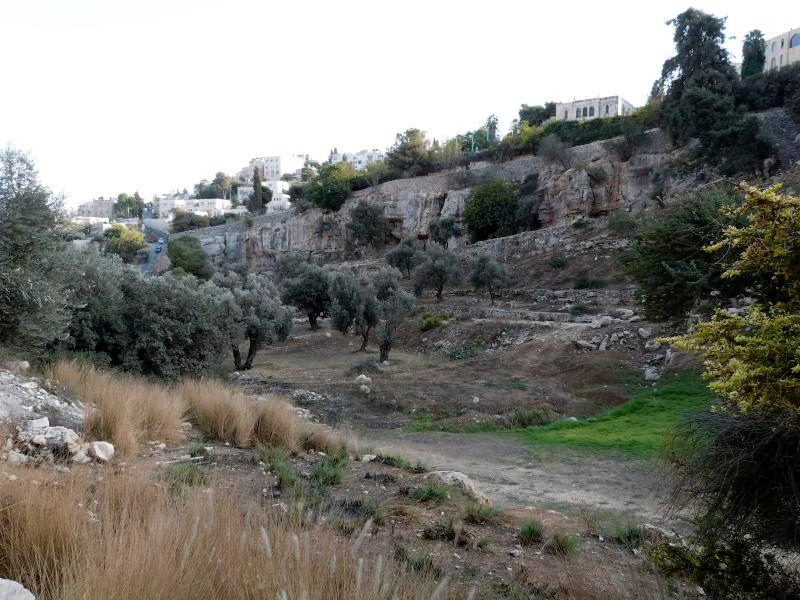
Today, that field still exists and is on google maps. It’s still called by the same name. It’s a beautiful place:
He did it with a kiss.
Life is full of ambitious people that are willing to do damaging, dishonest things to others to elevate themselves at your expense– to wear your hat — to sit in your throne — to receive your praise — to assume your authority — and they often do it to those close to them:
Betrayal never comes from an enemy. It comes from a place of trust.
It’s one of those timeless character and morality flaws that occupy every culture on Earth in every era of human history. Judas was deeply flawed — to the point of being broken morally and spiritually, but he was not unique– and wouldn’t be today, either.
The bright side, is they’re easy to spot: Just look for the field of blood. They will often do these betrayals strategically and repeatedly, in serial fashion to stay ahead in life, and, if you’re around them long enough, you’ll see the ground turn red around them. Key people keep disappearing around them that occupy a specific role in their life. Some of them speak of betrayal before disappearing. They’re standing in fields of blood. Akeldama is their reward.
They usually seal it with a kiss. They always get an Akeldama. They often swell and fall in it eventually when people start to recognize what they are — especially themselves. Most of them lack the capacity for that level of self-reflection.
So, if you know this pattern, you’ve probably helped a Judas or two get his 30 pieces of silver. If that’s you, understand this:
There are people out there that fully expected to get their come up off of your downfall. They did their most to make this happen, and now that you’re not down, and they’re not up, they’ve wasted all their resources and favors in the attempt to elevate themselves. As they realize they’re not elevated and will have to carry your burden, don’t have pity. Don’t have an ounce of pity. They need to stay strong and handle it like you did. These peoples’ pattern doesn’t just involve betraying friends, they do it to a specific role in their life — a role that is load-bearing to their current and future success.
This kind of fatherless behaviour causes them to bloat and swell, from your load, in their field bought with your blood money, their field of blood, their Akeldama, and they fall in it. Sometimes they know they deserve it like Judas did in the Papias account. Often, they don’t. The way they fall is by people realizing what they are. The treasury refused the blood money and branded Judas. Everyone knew.
I do prefer the Papias account of how Judas ended because it is also so universally inevitable. In the Papias account, Judas was hung from a tree. He was then cut down before he choked out, and he kept living. His body started to swell. The swelling didn’t stop. He got so bloated he couldn’t fit through a gap a wagon could drive through — his head alone wouldn’t fit. His eyes sank so deep into the swollen flesh he couldn’t see out. He stank so badly that nobody would go near him. Pus and worms ran out of his swollen genitals. He lived like that on his own piece of bloody land until he finally died there, and his corruption made that area of land unusable afterwards from what was left of him. He left the smell of decay where he made promises of prosperity.
In modern times I usually see this where the Judas archetype assumes a position of trust in a structure, and then the betrayal is to burn someone’s image to distract from their failure, or sometimes it’s so they can isolate a narrative that is important to their progression in a power structure – or pay — the classic “you have to be bad so that I can be good” failure that you’ve probably also seen a few times yourself. I don’t see that in the Judas story, but I do see it often in those situations, so I guess we’d want to modernize the archetype to have a new name that includes someone damaging you for the purpose of hiding your excellence to their benefit so that they can more openly lie to elevate themselves at your expense. The modern 30 pieces of silver is a self-serving narrative.
There’s always a Judas, or a Quentin, or, oh I don’t know, any, oh– rock on your path that wants what you have but can’t do what you do in order to get it. So they settle for merely appearing to. They’ll try to consume you for it, and it doesn’t work that way, the same way some aboriginal tribes think that eating a person steals their strength. What they end up with is a temporary benefit, alot of noticing they can’t engineer their way out of when load-bearing structures can’t bear load, and an inescapable moral failure branded on them through the money and all the things they buy with it.
So focus on just being the great person your Judas saw in you, just like before you met them while building the things yours coveted.